
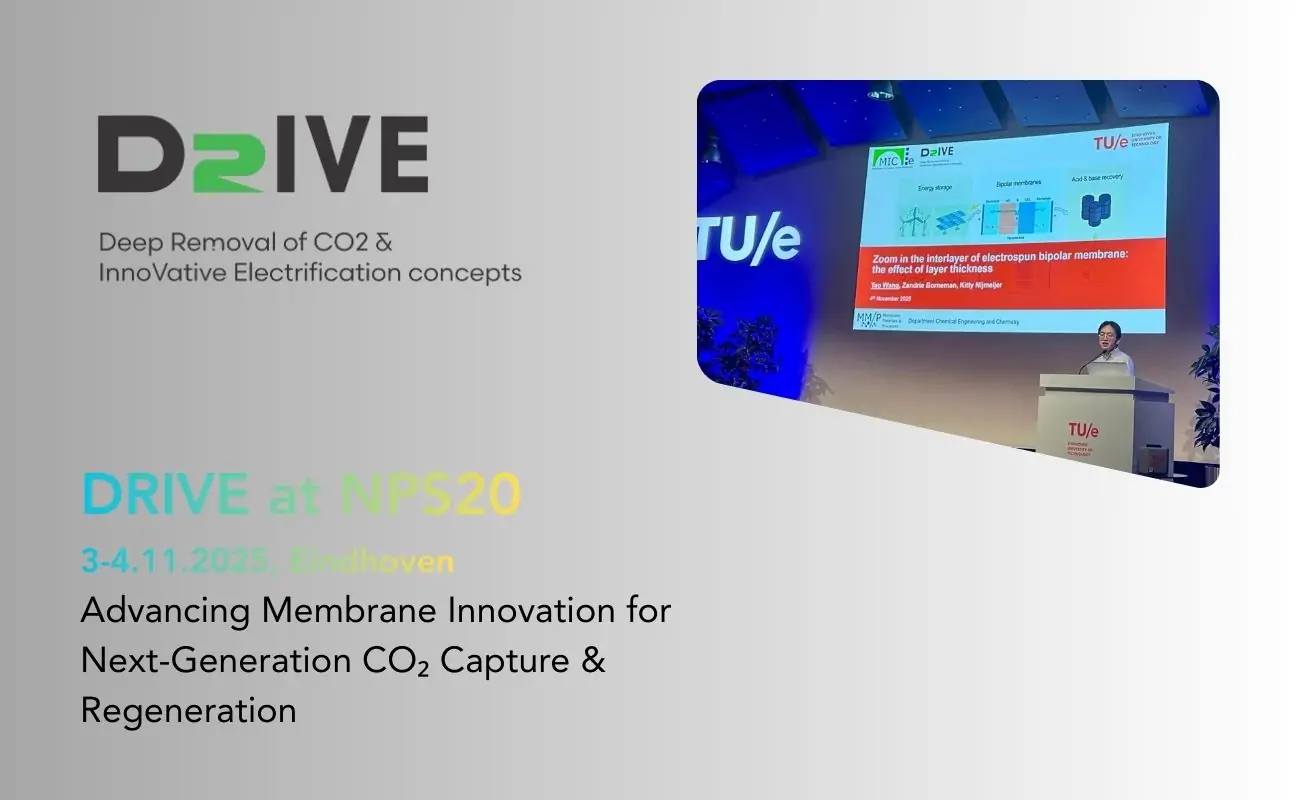
On 3–4 November 2025, the DRIVE project was proudly represented at NPS20 – The Netherlands Process Technology Symposium, hosted by Eindhoven University of Technology. The conference brought together leading academics, industrial researchers, engineers and innovators working on breakthrough technologies in chemical engineering, sustainable processes and energy transition.
Among the advanced research contributions showcased this year was the presentation “Electrospun bipolar membranes with a phytic acid–Fe³⁺ catalytic complex as the water dissociation catalyst” delivered in the Electrochemical Engineering session. This work directly supports DRIVE’s mission to accelerate CO₂ capture and regeneration technologies by improving the performance, efficiency and stability of key membrane components.
A Novel Approach to High-Performance Bipolar Membranes
Bipolar membranes (BPMs) play a critical role in electrochemical CO₂ capture systems, enabling water splitting into protons and hydroxyl ions-an essential step for solvent regeneration and carbon conversion. However, conventional BPMs often suffer from:
- High internal resistance
- Limited water diffusion
- Poor long-term mechanical stability
- Delamination between membrane layers
The research presented at NPS20 introduces an innovative electrospinning-based fabrication method, offering precise control over layer thickness and exceptional interfacial architecture.
Key scientific advances highlighted:
- Electrospun nanofiber mats create a highly porous 3D architecture that enhances water, proton and hydroxyl transport.
- A phytic acid–Fe³⁺ catalytic complex is integrated into the interfacial layer, accelerating water dissociation rates.
- Precise thermal hot-pressing enables strong interpenetration between the anion exchange layer (AEL), cation exchange layer (CEL) and interfacial layer—significantly improving mechanical stability.
- Reduced membrane thickness results in lower voltage drop and improved electrochemical performance.
- Experiments demonstrated that interface engineering, particularly between the AEL and IL, has a decisive impact on water dissociation resistance and overall BPM efficiency.
These findings provide valuable insights into how membrane micro-structure impacts performance—knowledge that directly benefits the development of next-generation regeneration units within DRIVE’s ZEUS system.
Why This Matters for the DRIVE Project
The DRIVE project aims to develop cost-effective, energy-efficient CO₂ capture and regeneration technologies for the cement, lime and energy-intensive industries. Membrane innovation is a cornerstone of this work.
The research presented at NPS20 contributes to the project by:
- Supporting the scaling-up of advanced BPMs suitable for industrial operating environments.
- Enhancing the stability and efficiency of electrochemical regeneration, reducing energy consumption.
- Providing a clearer understanding of structure–performance relationships, guiding future material development within DRIVE.
- Strengthening collaboration between DRIVE partners and top European research groups active in membrane materials, electrochemistry and process intensification.
Participation in NPS20 highlights the project’s active role in the scientific community and reinforces DRIVE’s commitment to open knowledge exchange and industrial impact. As the project progresses towards demonstration and pilot validation, these scientific contributions help accelerate the adoption of innovative CO₂ capture pathways across Europe.