
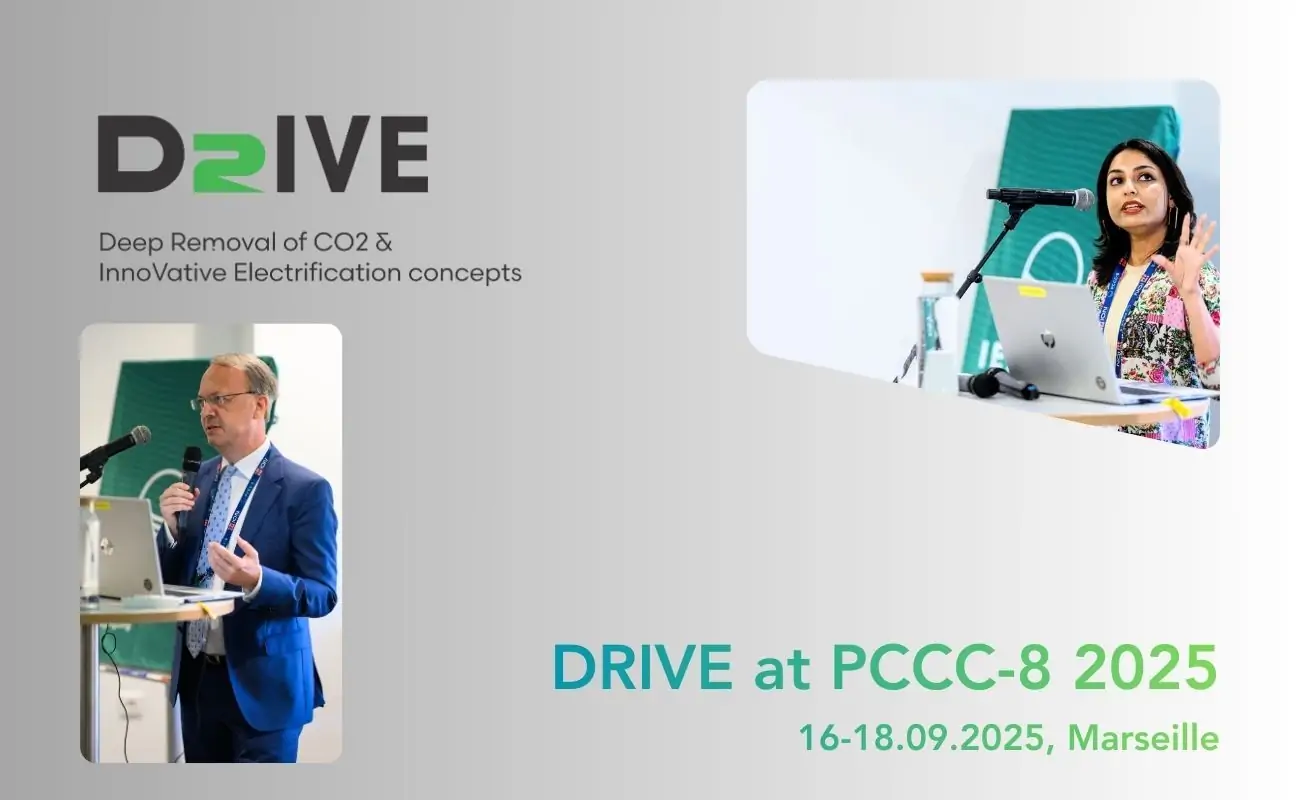
With over 230 delegates from 23 countries and 115 technical presentations the 8th Post-Combustion Capture Conference (PCCC-8) took place in Marseille, France, from 16.–18. September 2025. PCCC-8 marked the largest Post-Combustion Capture Conference to date in both scale and scope. The DRIVE project contributed with two presentations on deep removal to PCCC-8.
RWE presented the results of four test campaigns on deep removal with thermal regeneration of the amine-based solvent that have been carried out so far at the capture pilot plant at Niederaussem. The feasibility of deep CO2 removal has been demonstrated in 24/7 operation over extended periods using the non-proprietary solvent CESAR1. While until now, worldwide tests on highest capture efficiencies have been carried out mainly for just a few hours, the scope and results of DRIVE have taken us into a new dimension:
- More than 3,800 operating hours with capture rates >98%.
- CO2 concentrations in the CO2 depleted flue gas <100 ppm have been achieved (capture rate 99.95%) which means less than a quarter of the CO2 concentration in ambient air to date.
- Non-interrupted operation over 292 hours with a capture rate of 99.70%, 539 ppm.
For both, fresh and aged solvent that was used without any treatment for around 22 months, it was shown that these highest capture rates are not achieved for free and that around 50% more heat is needed to regenerate the solvent. Deep removal means an environmental and economic trade off regarding high CO2 capture efficiency, energy demand and cross-media effects. Following the holistic approach of the DRIVE project, in addition to the energetic effects of deep removal it was also presented that emission mitigation technologies are available to effectively control the emissions. For the scalability of deep removal, accurate process simulations are crucial. Therefore, an important result of DRIVE is that the simulation results provided by HOVYU are generally able to represent the experimental data regarding capture rates and volatile emissions well for the aged CESAR1 solvent.
In the second presentation of the DRIVE project at the PCCC-8 conference, HOVYU explained the functionality of deep removal with electrochemical regeneration of the solvent based on their ZEUS system, which uses a two-step regeneration system for hydroxide-based solvents. The heart of the technology is a special class of ion exchange membranes – so-called bipolar membranes – developed at Eindhoven University of Technology, which allow to produce in separated compartments of the process at the same time alkaline hydroxide ions to capture the CO₂ and acidic protons which are used to regenerate the CO₂-loaded solvent.It was shown that the production of the membranes from hot pressing of porous nanofibers into dense bipolar membranes results in membranes with slightly higher performance compared to commercial membranes. In addition, an outlook was presented on the next scale-up step on the development path, using TNO’s capture mini plant.
Both presentations attracted great interest, and the conference provided an excellent platform for intensive exchange with experts in the field of carbon capture from around the world.